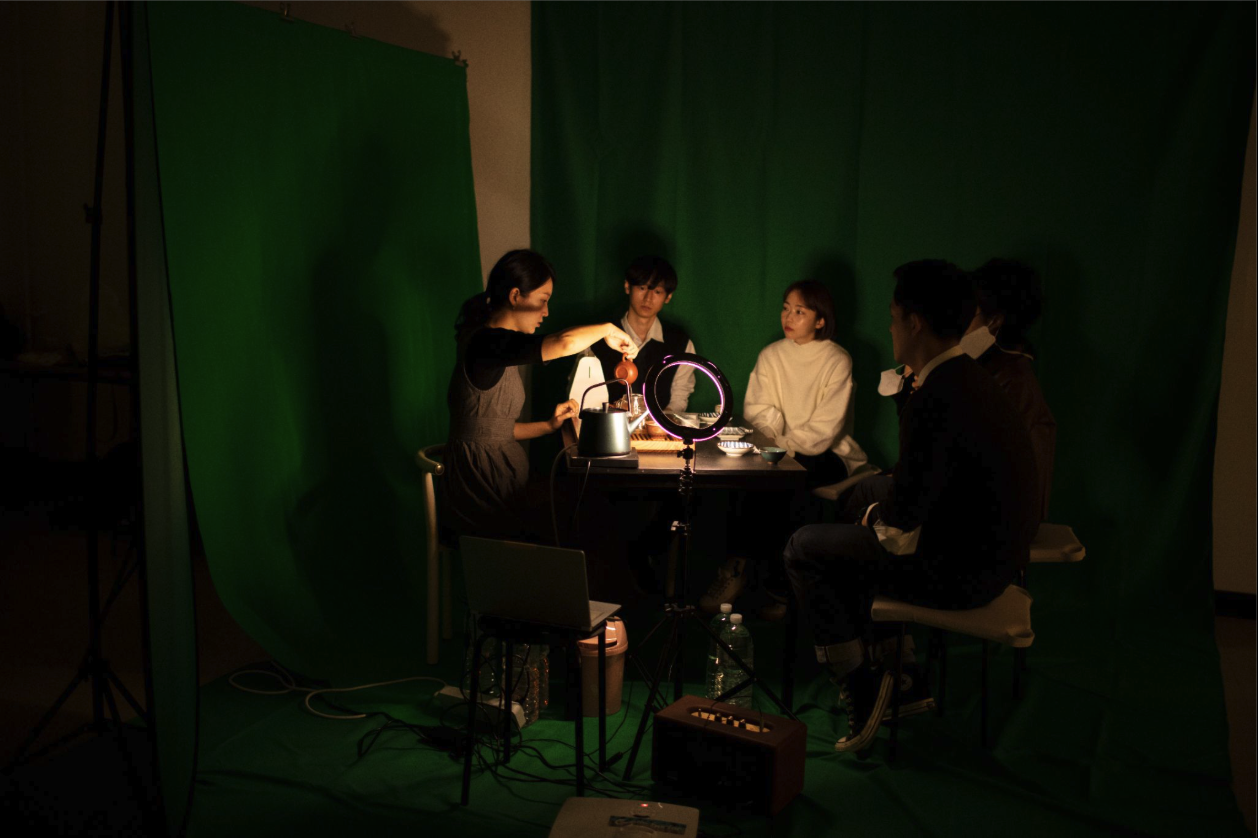
Sweet and Slight begins by serving Manno tea processed in 2018 and Bulang Mountain old tree tea processed in 2008. This performance event, lasting about an hour, guides the audience to perceive matter—which constantly changes within time—from a macroscopic perspective. Amidst the harmony of scent and touch, light and conversational voices, and music, the story of the energy called stars passing through time, dying, and being reborn approaches like a distant echo. "Tea leaves, our bodies, and all living, breathing matter came from stars..." The audience senses the present dreamily, yet more vividly than ever before. When the moment of sensation ends and the audience leaves the space, the warm lingering sensation left within their viscera is a fragment of a star. How will that heat energy, which will soon cool down, be remembered? As coziness, emptiness, preciousness, unfamiliarity, or perhaps something else. It is something that makes one feel that every moment of life is a fleeting instant on the continuous loop of the birth and death of stars.
The performance consists of a conversation between an astronomer and a performance artist. The stories surrounding warm blood, gravitational attraction, baryons, the sensation of chewing the body, and energy continue. We invite you to the time of Sweet and Slight, where you can feel the heat energy inside your body, notice the differences in taste and texture, and sense the times of maturation.
Performer, Video Production: Shin Hee-jeong (Performance Artist) Narration: Jeong Mankeun (Astronomer), Cho Sumin (Writer)
- This performance was produced as part of the Changdong Residency Move-in Report 2021: Water, Grass, Body.
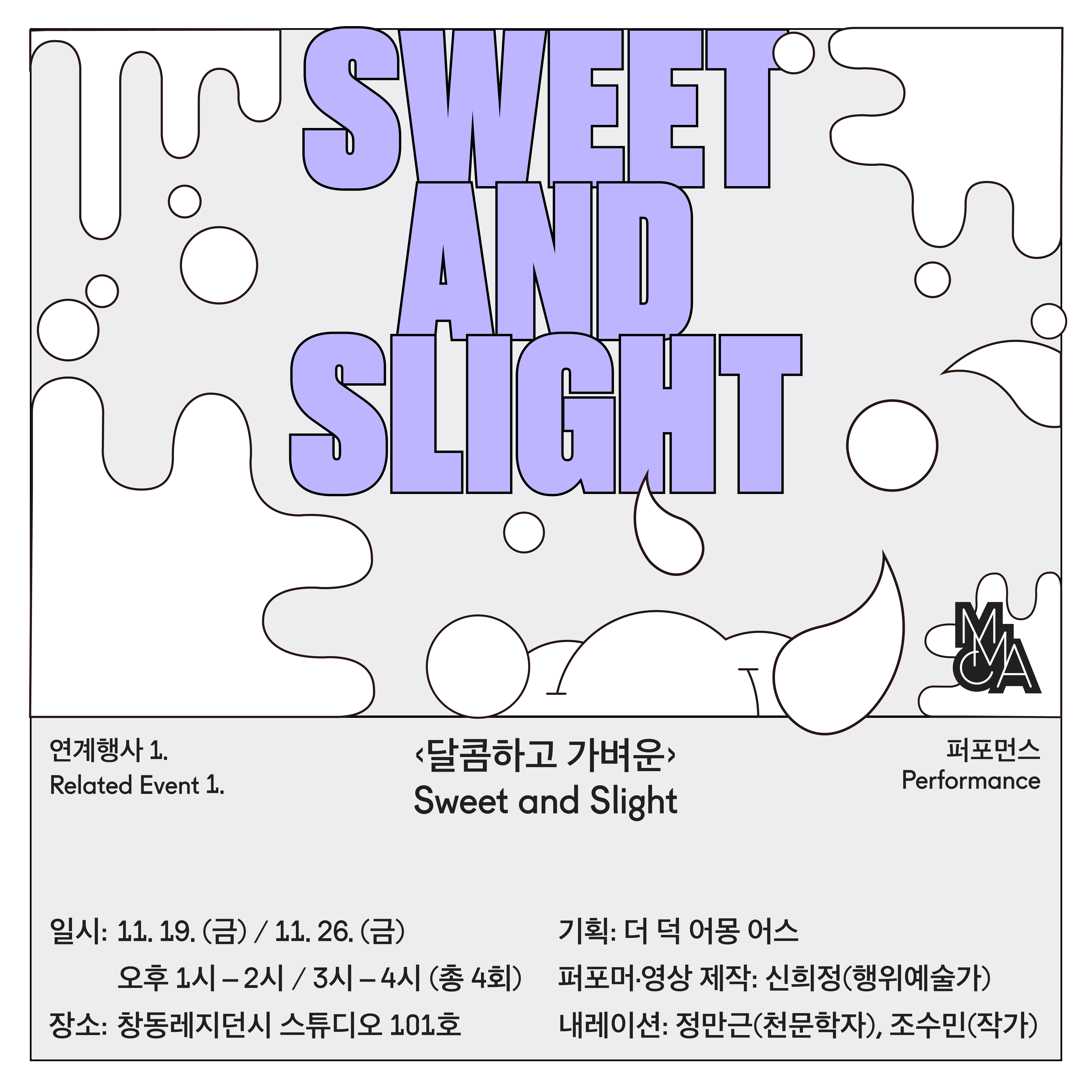
Poster
Preface
Everyone looks at the stars at least once in their lives. In any era and in any region, as long as civilization has existed, humanity has never averted its eyes from the stars. The presence of shining stars in the dark night sky was enough to stimulate the sensibilities and curiosity of the humans who made eye contact with them, and the question, "What is a star?" has been engraved in people's minds since ancient times. The fact that curiosity about stars is inevitable is an interesting story in itself, but what is even more surprising is the answer the stars give us. It is the fact that stars are the origin of our bodies, life, and furthermore, all the complexity in the world.
To understand this, it is necessary to go back to the primordial universe where complex matter did not yet exist. The Big Bang theory explains the origin of the universe as the expansion of a singularity. According to this theory, the universe passed through a very small and hot period before facing a dark age where it cooled down to become empty and cold. In the universe of this dark age, matter existed only in simple forms, mostly hydrogen and the rest helium. At this time, there was a simple logic that caused the movement of these simple materials, which was the law of universal gravitation: "everything attracts each other." According to this law of gravity, matter condensed, and as a result, the first stars were born, bringing an end to the dark age.
The existence of stars is marvelous in two major ways. First, complex matter is born within them, and second, that process shines. To understand this process, we need the logic of Einstein's most famous formula, E=mc², which dictates that "mass is energy." The interior of a star, tightly bound by gravity, is a high-temperature, high-density environment and the only place in the universe where nuclear fusion can occur. Through nuclear fusion, simple elements evolve into complex elements, and mass is emitted as energy, reaching us as light.
However, for stars to truly become the origin of everything that surrounds us, one final process remains: the death of a star. If stars were eternal, the complexity born within them would never be transmitted to outer space. Fortunately, stars have a finite lifespan, and a star that has reached the end of its life meets a grand demise called a supernova explosion. In a single moment, a supernova emits a bright light that far exceeds the light the star emitted throughout its entire life, distributing various elements ranging from carbon, oxygen, neon, and magnesium, all the way to iron, into space. Therefore, the abundant elements that exist in the world are the accumulated result of the deaths of countless stars, and the graveyard of stars is, in effect, the cradle that conceives all life anew.
Carl Sagan, the author of Cosmos, left us with the phrase, "We are made of star-stuff." This may sound like a romantic metaphor on the surface, but it is not merely a metaphor; it is an actual truth revealed by 20th-century astronomy through starlight. What does this intuition tell us? It tells us that looking at the stars is an act of facing our own origins, and that our birth and death are part of the massive cycle of the birth and death of stars. Since birth, we eat, see, sense, and gradually die throughout our lives. This human life seems very complex up close, but it is extremely simple in that even this complexity resembles the stars.
Now, let us return to the beginning. The reason humans know about the origins of stars and matter is essentially because stars shine, and humans cannot ignore them. Therefore, arriving at our own identity as circulating matter and energy is also an inevitability brought about by the shining of stars. How should we treat this astonishing flow? Furthermore, how should we accept our dying bodies? We have no other choice but to simply accept it.